Story: India McCarty @indiamcc13
Photos: Lindsey Byrnes Lindseybyrnes
Assist: @partypartynails
Styling: Liza Ace @goatprincesse
Styling Assist: Declan Fine
HMU: Johnny Stunz @stuntzbeauty
Sawyer CD: Nicholas J. Sauer @Nicholasjsauer
Sawyer Hill has never been one to take the easy way out. Whether it’s his years playing local bars and pushing his music on social media before finally breaking through, or his commitment to exploring complicated topics through his debut album, a country-rock rager titled Everybody’s Home, Nobody’s Happy, Hill has always been up for a challenge.
“Wanting to write about easy stuff, that would be really easy to do. It was the harder topics that proved really challenging in terms of writing the actual song and making sure it will stand the test of time,” he said in a conversation a few days before the album dropped.
Everybody’s Home, Nobody’s Happy is filled with tracks that dive into these “harder topics,” starting with album opener “Goin To Hell,” an acoustic song that details his complicated feelings about religion—and marked the beginning of the album’s creative process.
“I didn’t know what to do with it [at first],” Hill said, explaining that it felt “too vulnerable” and “was so autobiographical,” he wasn’t sure he ever wanted to release it. But, upon further reflection, “I knew I wanted to tell people about me and try to go a little bit deeper,” he said.
The song’s subject matter emerged unexpectedly. A guitar progression reminded Hill of Leonard Cohen’s “Hallelujah,” opening the door to memories of his upbringing and family.
“It wasn’t like, ‘Oh, I’m going to write about my religious trauma today,’” he explained.
“Goin To Hell” ultimately “spawned the creative as a whole for the record,” a project that blends everything from outlaw country and Johnny Cash-style delivery to Billy Idol-esque guitars and Nine Inch Nails-inspired production.
“I just wanted to do what I do,” Hill said when asked about juggling genres. “I wanted to write a cool song.”
For Hill, that process usually begins with a chord progression, followed by a melody and whatever he’s feeling. Many of the songs were written in his living room, alone on acoustic or electric guitar; others came together with friends and collaborators. Before deciding how loud or heavy a track should become, he wants the writing to hold up on its own.
“I don’t like to use big words. I like to communicate things simply,” he said. “I think that’s something that country music does really well. It takes a complex idea, communicates it in a simple way that everybody can understand.”
Once he enters the studio, those songs can take unexpected turns. “Tyin’ The Noose” began as a soft, melancholy acoustic track before developing its upbeat arrangement, fuzzed-out bass, and guitars inspired by Billy Idol’s “Dancing with Myself.” Hill’s influences stretch across decades and genres, with each song finding its own combination.
On “Ghost Town,” which addresses the opioid crisis, the Beatles’ “Helter Skelter” helped inspire the riff. For the lyrics, Hill looked to Shel Silverstein’s playful way of communicating, finding a route into a heavy subject through accessible storytelling.

Top: Artist’s own Blazer: RAVEN CRAVE Shorts: MILLA STONE courtesy of THE ARCHIVES SHOWROOM Boots: Creative team’s own Pearl Necklace: RARE ROMANCE courtesy of ETCETERA Rings: Artist’s own


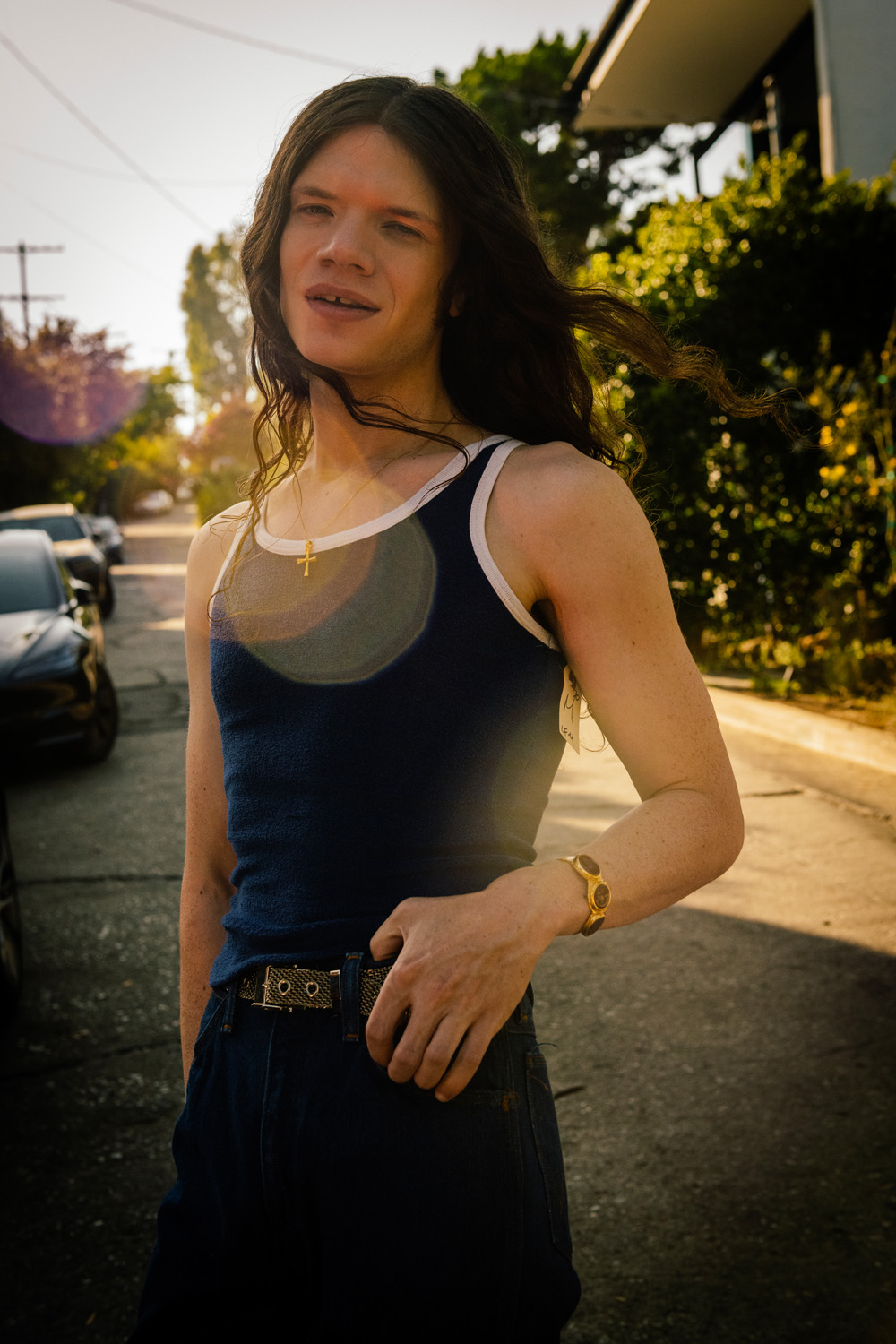
Top: Artist’s own Shorts: Creative director’s own Boots: Stylist’s own Cross Necklace #1: Courtesy of THE ARCHIVES SHOWROOM Cross Necklace #2, Rings and Bracelet: Artist’s own
It’s a goal he achieved; from a writing standpoint, Everybody’s Home, Nobody’s Happy boasts songs with poignant lyrics, covering faith, heartbreak, depression and, on the single “Jimmy’s Gone Numb,” the economic struggles so many people around the country face.
“I never really like to do the whole political thing, because I feel like it’s really easy to be really lame about it and really cheesy about it,” he said of the song. “It’s really hard to thread that needle. And then, if you’re not really lame or cheesy about it, it’s like, how [do you] make it last the test of time?”
Hill continued, “I talk to my friends and my family, and all these people around the country, and I keep getting these same sentiments echoed…and I think I wanted to just capture all that, and put it in a song, and specifically not offer any real solution, because I feel like that’s when it gets kind of corny.”
His Arkansas upbringing runs through the album’s sound and visual world. Slide guitar became a connecting thread, appearing across the record in different forms, from familiar Southern textures to more distorted, experimental passages.
“I think the country rock thing is an attitude,” he said.
The snake on the album cover also carries a personal reference, drawing from Appalachian and Southern snake-handling traditions. It extends the religious imagery of the music into a visual language rooted in the environments Hill is writing about.
“This Southern religious thing is mixed with this suburban, surreal kind of vibe,” he explained. “So I can only tell my story, but that’s where I was coming from.”
Hill isn’t trying to make his experience speak for everyone from the South. He’s interested in expressing the details of his own life, including the contradictions. That instinct carries into his love of pairing dark lyrics with bright arrangements, giving listeners room to respond in their own way.
“I love not telling somebody how they should feel when they listen to a song and letting them have their own interpretation or meaning of it,” he said. “They can listen to it in whatever context they want.”
The songs on Everybody’s Home, Nobody’s Happy can get heavy, something Hill acknowledges. But at the end of the day, sharing his perspective on his own terms is the most important thing.
“I didn’t really think about a whole lot of other people while making the record,” he said. “I was mainly thinking about me and what I wanted to tell which, I’ve been told by many people in the industry, ‘You gotta write for your audience.’ And maybe I should, and maybe that would be financially advantageous to do so, but I have this nightmare of me writing a whole body of work for someone else, and them not even liking it. To me, that’s my worst nightmare.”
He paused, then added, “I could die next month, I could die tomorrow, and whatever I do, I need to be proud of. I need to be able to stand by it in the next 40, 50 years, and that’s what I strive to do.”
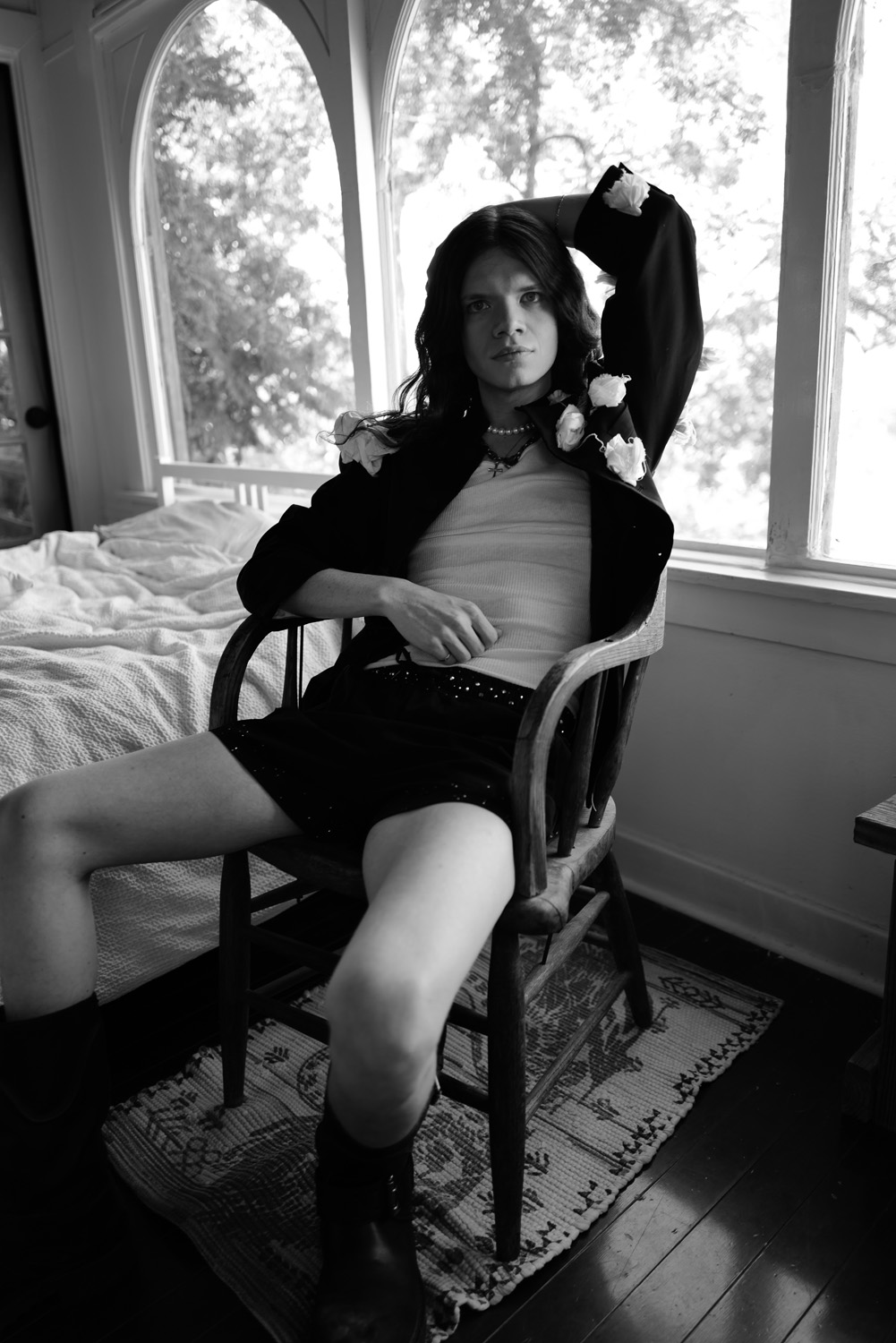

Top: Courtesy of PALACE COSTUMES Jacket: Creative director’s own Necklace: Artist’s own