
Text: Micah Greenberg
With Madras, the Tamil-Swiss artist finds freedom in trusting the process, embracing her roots, and knowing when to get out of her own way.
Priya Ragu had a plan. She and her brother would go to Kerala, spend two weeks writing music, and return with the makings of an album. Simple enough, right? Except that two weeks later, they had exactly two song ideas to show for it.
“I was thinking, oh my God, this is going nowhere,” she recalls, laughing at the memory. “And at that point, I just surrendered. I realized you can’t put pressure on creativity. It comes when the moment is right.”
For Ragu, surrender doesn’t come easily. The Tamil-Swiss singer-songwriter is quick to identify herself as the impatient half of her creative partnership with her brother, producer Japhna Gold. He’s the one who trusts the timing. She’s the one checking the clock.
Fortunately, patience has its rewards. The siblings’ latest collaboration, Madras, is a jubilant collision of R&B, disco, hip-hop, and South Asian musical traditions, delivered with a buoyancy that makes its ambition feel effortless. Recorded in Chennai with local musicians, the album features orchestral strings, flutes, and a children’s choir. It’s also a record that might never have existed had its creators stuck to a schedule.
“There was no time pressure, or really any kind of pressure,” Ragu says. “We had this opportunity to create without outside distractions. Everything felt peaceful and quiet, and I could fully focus on the music.”
The irony isn’t lost on her. An artist whose music practically insists that you get up and move has discovered the creative benefits of sitting still.
Much of Madras was written during an extended stay in India, where Ragu and Gold traveled between cities, collecting impressions rather than chasing songs. Kerala was new territory for her, as were other stops along the way. The unfamiliar surroundings offered something a studio back in Switzerland couldn’t have reproduced.
“I don’t think it would have had the same sound,” she says. “I was discovering new places and cities I’d never been to before. We gathered so much inspiration from those experiences.”
The album takes its name from the former name of Chennai, a city whose legendary Marina Beach is among Ragu’s most immediate associations with the project. Asked what sound comes to mind, she offers something less geographically specific: ’70s disco.
It’s a fitting combination for an artist who has never been particularly interested in keeping musical traditions in their designated lanes.
Recording in Chennai also meant working with local musicians, including a children’s choir whose young singers had only a few days to learn their parts. When Ragu began imagining additional arrangements during the sessions, she worried they’d be too complicated to master on the spot. The children promptly proved her wrong.
“I thought some of them might take days to learn, but the children were able to sing them right away,” she says. “I was so impressed.”
There’s something appealing about the image of Ragu, having finally learned to abandon her own timetable, discovering that a roomful of children can accomplish in minutes what she assumed would take days.
Her relationship with Gold is similarly instructive. The siblings have spent years developing a shared musical vocabulary that seems to bypass the friction familiar to anyone who’s attempted a creative partnership with another human being, let alone a family member.
“We speak the same musical language,” she says. “Sometimes he’ll write something, and I feel like I would have written exactly the same thing. When you work with somebody else, you might have to convince each other. With us, there’s none of that.”
If making Madras involved finding freedom from expectations, Ragu’s larger musical journey has involved reconsidering which expectations belonged to her in the first place.
Growing up in Switzerland in a Tamil household, she understood instinctively how to navigate two worlds. At home, there was Tamil music and cinema. Outside, the culture of her Swiss peers. She remembers the distinction without much angst, although she admits her younger self wasn’t especially enthusiastic about her heritage.
“As a teenager, I didn’t really embrace my Tamil culture,” she says. “I thought it wasn’t cool. I wanted to be more Swiss.”
It wasn’t until later that she became curious about the sounds and stories she’d grown up with.
“The older I got, the more I wanted to understand my roots,” she explains. “Where my parents came from, where they lived, the music we grew up listening to. All of those things influenced me.”
That exploration eventually became inseparable from her musical identity. But Ragu is careful not to turn her cultural heritage into a creative obligation. Her incorporation of Tamil rhythms and instrumentation isn’t an assignment in representation. Sometimes a song calls for tabla. Sometimes it calls for something else entirely. She can imagine making an acoustic record with nothing but guitar and voice, or even singing in Swiss German.
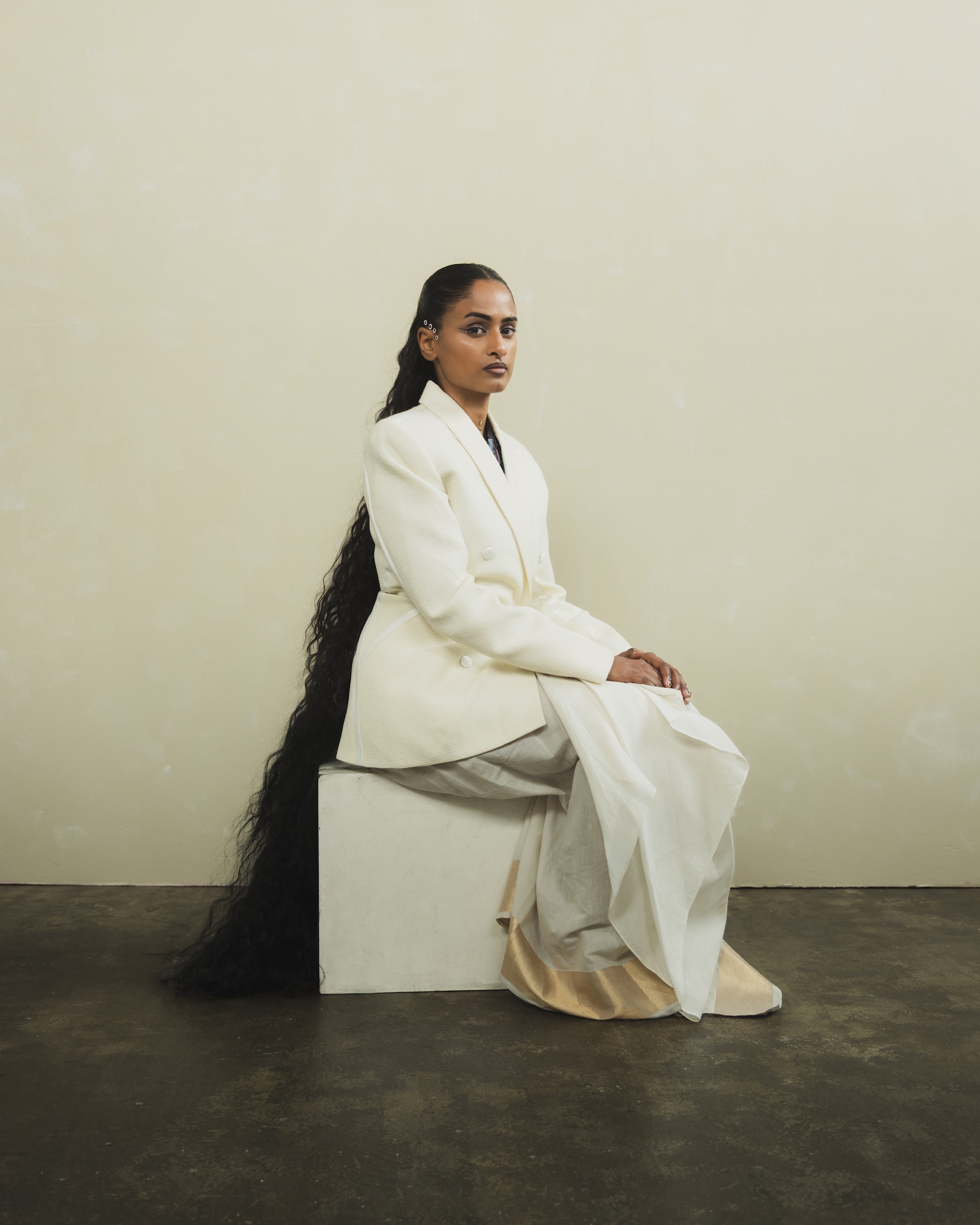
“I’m not doing it to represent the culture, but because I am the culture,” she says.
It’s a distinction worth sitting with. For an artist whose cross-cultural sound has become a signature, the freedom to move away from it may be just as important as the freedom to embrace it. Authenticity becomes a limiting proposition when someone else gets to decide what it should sound like.
Ragu’s interest in spontaneity carries over to the album’s visual world. Rather than enlist an army of stylists and production personnel, she and Gold worked with a filmmaker to create the accompanying visuals in Chennai and Switzerland. The three handled everything from wardrobe to location logistics.
“It wasn’t like a music video with 40 people on set,” she says. “It was just the three of us, almost like kids again, creating things together. We had so much fun.”
Fun is something Ragu takes seriously. Her previous album, Santhosam, explored questions of happiness and purpose. If that record was concerned with discovering what a meaningful life might look like, Madras seems less interested in asking the question than enjoying the answer.
Meditation has helped. Once an intermittent practice, it’s now part of her regular routine, offering clarity and some distance from the relentless activity of her own mind.
“It’s like watering a plant,” she says. “If you stop watering it, it won’t grow.”
Of course, enlightenment is all well and good, but so is a decent cappuccino.
Wherever she finds herself in the world, Ragu makes a point of seeking out a new coffee shop, ordering her preferred drink, and simply sitting for a while. It’s one of her favorite rituals, and she seems genuinely surprised that everyone doesn’t do the same.
Her listening habits, meanwhile, remain delightfully restless. Freddie Gibbs, Juicy J, Stevie Wonder, and Bob Marley are among the names that surface when she consults her Spotify history. Marley holds a special place, particularly when she’s riding her scooter with his music playing.
“It’s the most freeing feeling,” she says. “I always wonder, what did he put into this music? It’s incredible. It does something to your heart and soul.”
For all the kinetic energy of Madras, our conversation keeps returning to the quieter rewards of a life spent making music. Not fame or recognition, but time. The ability to wander. The luxury of following an idea without knowing where it will lead.
When I ask what feels possible now that might have seemed impossible a decade ago, Ragu doesn’t mention a career milestone or some long-imagined stage.
“I can decide where I want to go and just go there, even for months at a time,” she says. “Ten years ago, I dreamed about traveling the world. Now I can actually do it, and I really appreciate that.”
It’s a modest answer for someone making wonderfully immodest music.
Then again, perhaps that’s the point. Ragu spent years working toward the freedom to do whatever she wanted. Now she’s discovering the pleasure of not always needing to do anything at all.