
Interview: Mariana González.
Text: Escarlina.
Photos: Courtesy of artist.
On her newly released project “123,” Cameroonian-born singer and multi-instrumentalist Astrønne maps a path from personal self-trust to collective resistance, unpacking neurodivergence, Afropessimism, and the quiet alchemy of staying present.
Before a song ever becomes a statement to the outside world, Astrønne treats it as an anchor for her own nervous system. Having grown up uprooted and spent her adult life moving between creative ecosystems in Paris and London, the Cameroonian-born singer, songwriter, and multi-instrumentalist has learned to build stability from the inside out. On “123,” her new EP out now via StrataSonic Records, she distills that internal work into a three-part meditation on self-determination, mutual aid, and spiritual resistance.
For Astrønne, belonging has never been tied to a fixed map. Reflecting on her childhood displacement, she defines home as “fertile soil, starting with my own body.” Speaking from her experience as a nomadic, hyperactive person, she adds that this sanctuary is also “anywhere I feel understood, respected, and safe enough to recharge; starting with my own mind.”
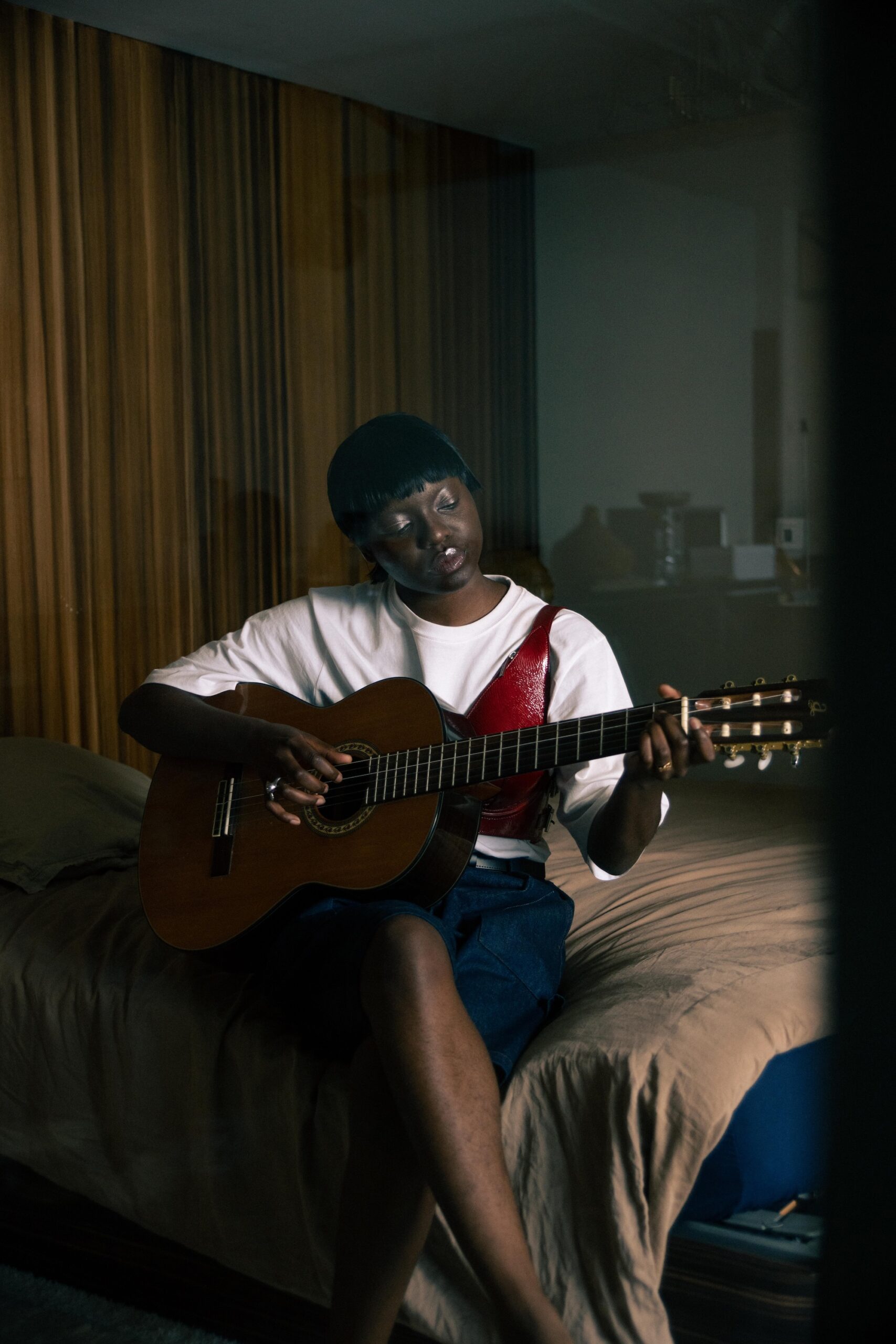
That instinct to carve out an intimate world took musical shape early in her childhood, though her path to her signature instrument came through compromise. “I first wanted to play drums, but my mom refused to protect the firefighter neighbours from the noise,” she explains. “She wanted me to play piano; I refused on principle. Then she brought me to an orchestral concert in a church and asked me to choose from all the instruments. I had my first crush on the harp when I was 5 years old.” Over the years, she taught herself guitar and piano as well, eventually folding those acoustic roots into a sonic palette spanning experimental R&B, folk, hip-hop, glitch, and sound therapy.
That fluid sense of self carries directly into her multilingual songwriting. Describing herself as “multiple,” she moves between English, French, and Spanish depending on the emotional terrain she wants to explore. For Astrønne, “English feels like an ego trip, French feels like shadow work, and Spanish is more escapism,” a dynamic that lets her honor her multiplicity without flattening her complexity.
On “123,” that multiplicity becomes an active practice of unlearning. “These three songs sounded delusional when I wrote them,” Astrønne admits. “They became sorts of mantras to help me remember what I think society wants me to forget and help me redefine what the status quo indoctrinated.”
The opening track and lead single, “1 2,” sets that reclamation in motion. Astrønne describes it as an ode to uniqueness, non-binarity, trialectical thinking, and self-validation. Yet she speaks about self-actualization without pretense, admitting she is still learning to follow her own advice and embody the transformation she sings about.
While “1 2” centers on self-reliance, “2 3” acknowledges that personal resilience has its limits. The track began as an online message encouraging people to seek connection during heavy moments before expanding into a slow-building, atmospheric meditation on collective care. Astrønne frames the song around honesty during moments of doubt, explaining that it is “less about never losing faith but rather about reaching out to trusted and loved ones whenever we do.” She describes it as “an ode to ubuntu philosophy, mutual aid, and collective therapy, to help melt the shame of asking for help when we most need it.”
On the closing track, “L6VE,” that impulse toward solidarity sharpens into political and spiritual conviction. Echoing James Baldwin’s insistence on our shared humanity, Astrønne channels love as an active force against indifference, calling the song “an ode to empathy and collective resistance” designed for “fighting the fascist moral apathy.”
Beneath that urgency sits a nuanced worldview shaped by Afropessimism and deep spirituality. While she spots sparks of collective courage in student uprisings and France’s yellow vest protests, Astrønne confesses she carries very little conventional hope. Instead, she relies on faith, which she playfully reclaims as her “delulu.” Looking back at histories of slavery, genocide, and torture, she notes that dreaming of liberation in the darkest places on earth has always required a radical refusal of logic. “Humanity lies beneath the surface; that’s why the revolution can’t be televised because it’s happening in our minds and hearts,” she reflects.
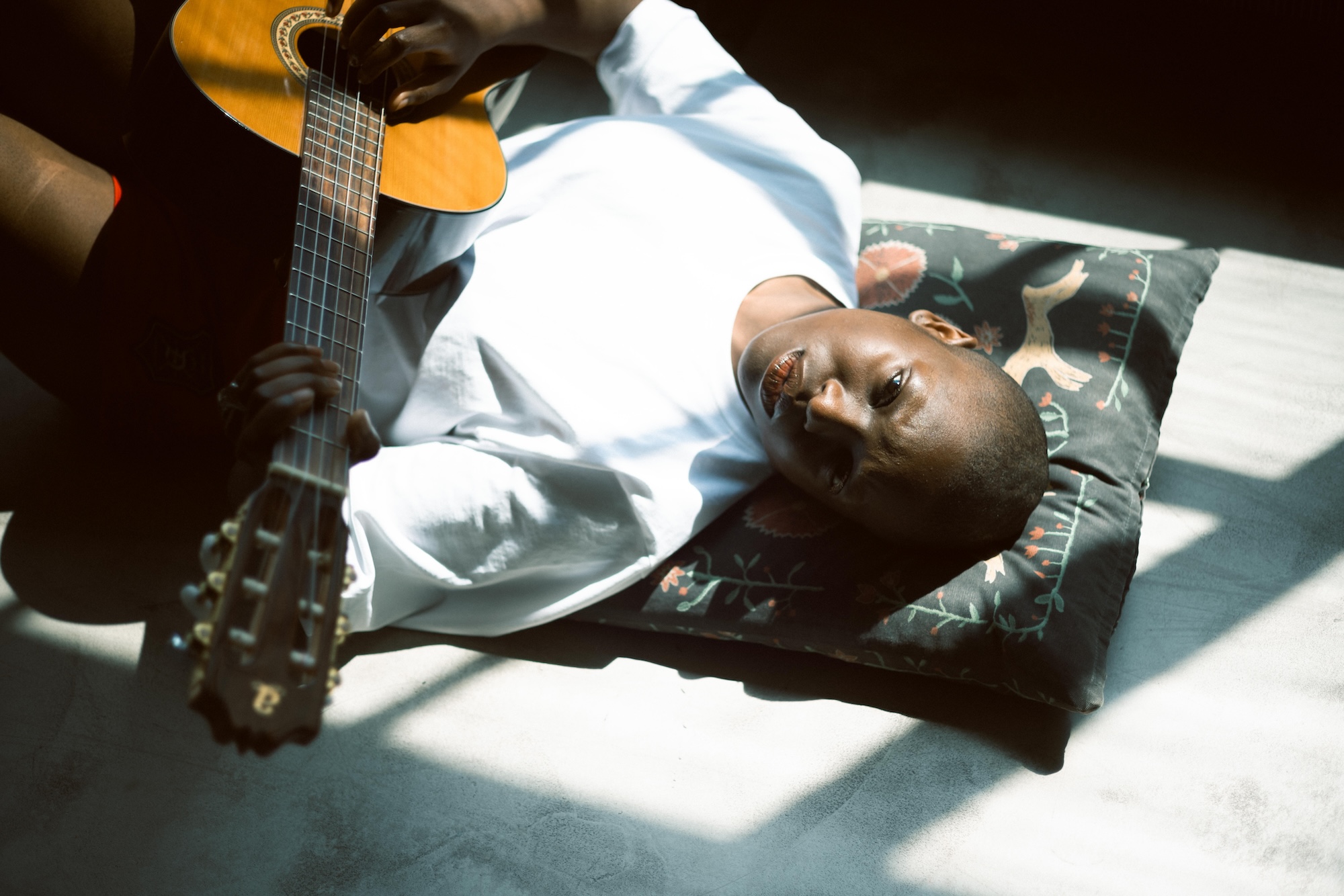
Stepping into public spaces to share such raw interiority remains an ongoing negotiation. Despite high-profile appearances across fashion and contemporary art, from performing for Louis Vuitton’s 2022 Virgil Abloh tribute and scoring Off-White’s 2025 runway collection to playing the Centre Pompidou during the 2024 Paris Olympics, Astrønne still experiences intense social anxiety. She questions the very premise of performing, wondering whether her discomfort is tied to neurodivergence. While the stress dissipates once she begins to sing, she speaks candidly about how overwhelming the stage used to feel.
“I used to cry profusely before and after singing, so I’ve come a looong way,” she says, before adding, “Now I have rituals to help me ground myself, including my favourite essential oils, a chanting bowl, and journalling.” Those grounding habits will remain essential when she heads out on tour in April 2027.
Staying anchored offstage requires just as much intention. Humbled by past experiences, Astrønne considers herself a lifelong student who treats mindfulness as a discipline, a sport, and a form of metaphysical curation. Surrounded by trusted friends she calls angels in her entourage, she rarely fixates on the future, though letting go of the past remains her biggest personal hurdle.
To stay tethered to the present, she leans into small, tactile joys that quiet her mind. Astrønne anchors herself in sensory details and solitary play. “I love drinking water. I love the rain. I love drawing circles with my compass, or putting makeup on without leaving the house.” That same appreciation for everyday intimacy shapes how she nourishes herself and connects with others, whether she is studying languages, including her mother tongue, or asking unexpected questions. “I love cooking for my loved ones and eating eggs in every shape or form. I love stretching, breathing, and cartwheeling. I love watching intense movies, doing Gong baths and talking to my brother.”
When asked what constitutes a beautiful life, Astrønne resists neat resolutions in favor of poetic contradiction. To her, beauty lives in the calm after the storm, the balance between solitude and community, and the willingness to embrace cyclical, divine nonsense. Rather than trying to win an arbitrary game, she focuses on decrypting the cards dealt at birth and finding joy in the play itself. Invoking Alejandro Jodorowsky’s film “The Holy Mountain,” she sees each day as an exercise in alchemy, taking whatever heavy weight life drops at her feet and turning it into gold.