
Photos Tamara Yajia / Story Adriana Pérez
Tamara Yajia has figured out how to talk about the uncomfortable parts of being alive—immigration, family, childhood, belonging, motherhood—without making any of them feel overly precious. Instead, she does what comedians do best: she finds the absurdity hiding inside the pain and invites us to laugh at it.
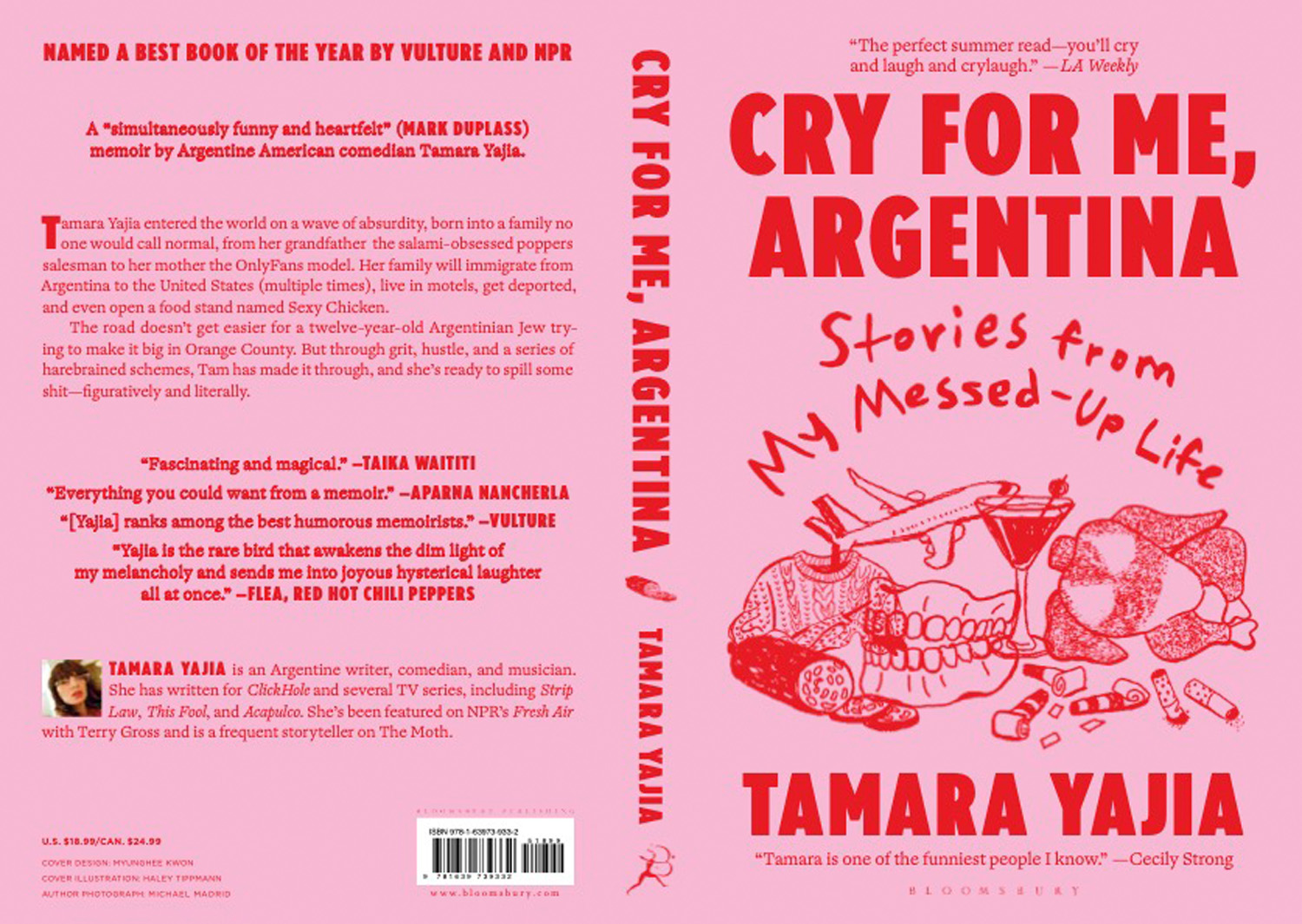
In“Cry for Me, Argentina,” Yajia turns memory into material. The result is a memoir about growing up between Argentina and the United States, being raised by an eccentric Argentine Jewish family, and trying to figure out what exactly makes a place feel like home.
Tamara Yajia was born in Buenos Aires and moved to the United States as a teenager. That in-between experience—belonging to two places while never feeling entirely of either—runs through her work. She has written for ClickHole and television series including This Fool, Acapulco, and Strip Law, while also becoming a regular storyteller at The Moth. She has appeared on NPR’s Fresh Air with Terry Gross, and Cry for Me, Argentina, published by Bloomsbury, was named one of the best books of the year by Vulture and NPR.
The memoir begins with a question that sounds simple enough: does Yajia actually want to become a mother? To help answer it, she starts talking to Betty Bakalman, an Argentine psychologist in her eighties. Naturally, the conversation quickly becomes much bigger than motherhood. It becomes an excavation of childhood, family, memory, and all the weird little things we inherit without realizing we’re carrying them.
And Yajia’s childhood offers plenty to excavate.
There are chaotic beginnings, complicated family dynamics, cultural displacement, early encounters with performance, and the particular kind of nostalgia that can hit you when you’re far away from the place you’re nostalgic for. The memories aren’t necessarily neat or sentimental. Sometimes they’re embarrassing. Sometimes they’re painful. Sometimes they’re completely fucking bizarre.
That’s where Yajia’s comedy comes in.
Her writing has the observational intimacy of David Sedaris and the fearless willingness of Samantha Irby to put sex, bodies, shame, family dysfunction, and emotional mess directly on the table. But Yajia’s voice is distinctly her own. There is a particular Argentine flavor to the chaos: affection can be overwhelming, boundaries can be theoretical, and family stories have a way of becoming mythology.
Rather than smoothing those edges out, she leans into them.
For Yajia, comedy isn’t really an escape from difficult subjects. It’s a way of getting close enough to them to actually look.
That becomes especially apparent in the way she writes about immigration. Moving countries as a teenager means learning how to translate yourself—not just your language, but your personality, your references, your history, your sense of humor. You become fluent in one world while carrying another one around inside you.
Cry for Me, Argentina lives in that tension.
It moves between Argentina and the United States, childhood and adulthood, nostalgia and reality, the person Yajia was and the person she has become. The past is never simply the past. It keeps showing up, often at the most inconvenient moments, asking to be reconsidered.
After years of bringing her stories to stages, television, and spaces like The Moth, Yajia brings that same instinct for performance to the page. But the memoir gives her something a stage can’t: room to sit with the memories after the laugh.
And maybe that’s what makes the book hit.
The jokes aren’t there to make the difficult things disappear. They’re there because sometimes laughing is the only way to admit how strange, painful, ridiculous, and beautiful something really was.
Somewhere between Argentina and America, family and independence, nostalgia and embarrassment, Yajia finds a version of belonging that isn’t particularly tidy—and doesn’t need to be.
She doesn’t make peace with the past so much as learn how to make it funny.
And honestly, that might be better.

CONNECT WITH TAMARA
INSTA